

Robert Treat Paine
Artist:
Location:
Location
Neighborhood:
Type:
Year:
Medium:
Collection:
Funders:
Description:
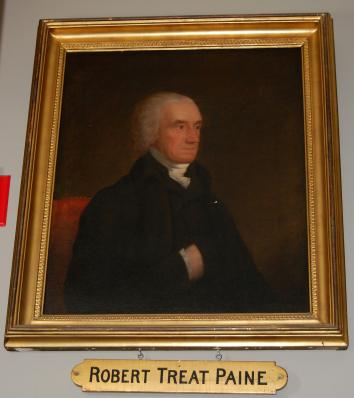
Robert Treat Paine (1731-1814) was a minister and lawyer who served as the Massachusetts representative in signing the Declaration of Independence. As a lawyer, Paine led the prosecution against the British troops involved in the Boston Massacre, with John Adams acting as defense attorney. As a legislator, Paine served in Massachusetts’s provincial assembly and in the Provincial and Continental Congresses. He participated in drafting the Massachusetts constitution and became the Commonwealth’s first Attorney General. Paine ended his legal career as a judge on Massachusetts’s Supreme Judicial Court.
In the posthumous portrait of Paine, the artist (an unknown painter) shows the Boston prosecutor with his hand thrust in his jacket, a pose often referred to as “Napoleonic,” after the traditional depictions of Napoleon where his hand is similarly hidden in the folds of his clothing. There are a number of theories as to why Napoleon, and others, chose to pose in such a manner, probably the most persistent being the “arm and a leg” explanation, or the idea that portrait painters charged more if they had to paint their subject’s arms or legs (hence the phrase “costing an arm and a leg”). As tempting as it may be to believe this explanation, there is no evidence that painters charged extra for hands or feet. Quite simply, the hand tucked inside the coat was a popular pose for a dignified gentleman of the time.